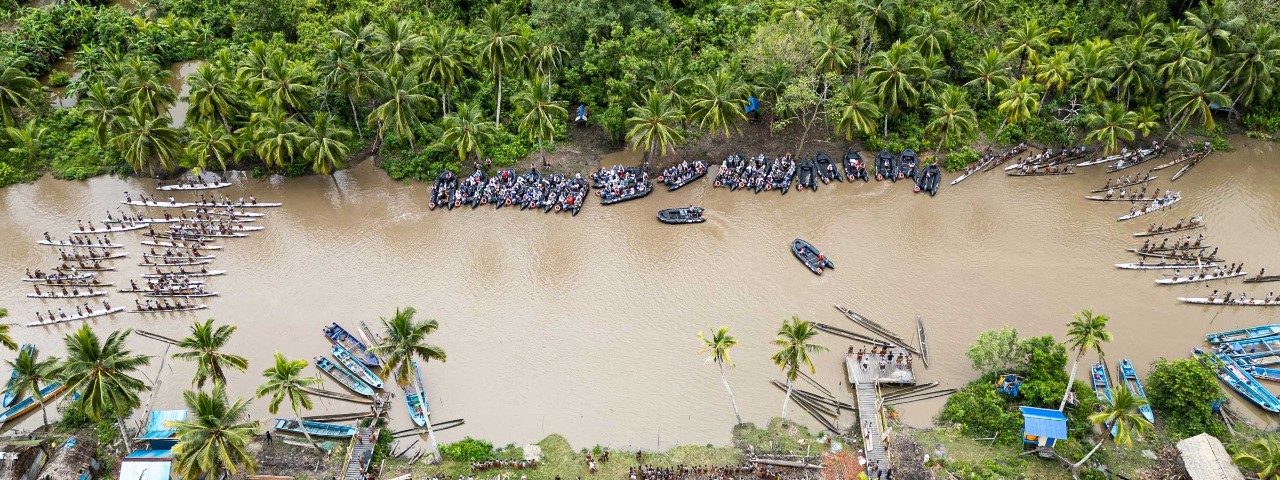
Along the remote southern coast of Papua, the Asmat region is defined by an intricate network of rivers, mangrove forests, and tidal lowlands where land yields to water. Villages rise on timber stilts above saturated ground, connected by narrow wooden boardwalks that serve as streets in a landscape shaped by tide and monsoon rain.
Arrival is by river, following winding waterways that lead inland through dense mangroves toward Per and the surrounding communities. Canoes remain an essential form of transportation across the region’s waterways, reflecting a way of life closely tied to river and sea.
Nearby, Agats—the largest town and administrative capital of the Asmat Regency—lies along the southern bank of the Asewets River near its mouth at the Arafura Sea. Established as a Dutch outpost in 1938, it became an early point of sustained contact between the Asmat people and the outside world.
The Asmat are internationally recognized for their woodcarving tradition. Ancestral figures, shields, drums, and towering bisj poles embody lineage, spirituality, and social structure—an artistic language that continues to shape community identity today.