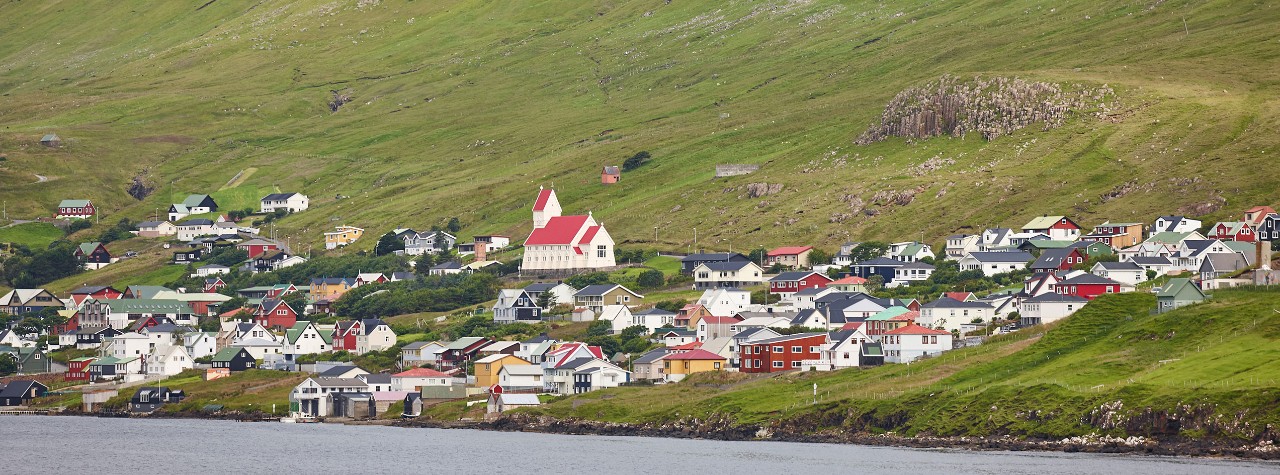
Tvøroyri sits along the calm, fjord-bound waters of Trongisvágsfjørður on the eastern coast of Suðuroy, the southernmost island of the Faroe archipelago. Warehouses and quays line the harbor while steep green slopes rise directly behind the village, creating a setting where settlement and landscape meet in close proportion.
Founded in 1836 as a Royal Danish trading post, Tvøroyri grew into the island’s principal center of commerce and maritime activity. Though home to fewer than 1,000 residents, it remains one of the Faroe Islands’ important fishing ports, with aquaculture and related industries continuing to shape the local economy. The harbor still reflects this working heritage, where boats, nets, and processing facilities are part of daily life.
The white timber church, built in Norway and assembled here in 1908, stands near the waterfront as a quiet landmark. Neighboring villages extend along the fjord, forming a connected coastal district shaped by shared history and exchange.
Beyond the harbor, Suðuroy’s wind-cut terrain unfolds quickly. Seabirds gather along the island’s rugged western cliffs, where vast colonies return each spring to nest above the North Atlantic.
At Tvøroyri, the steady rhythm of the fjord links harbor, hillside, and history.